History of Bavaria The region north of the Alps was inhabited by Celts and was part of the Roman Empire until (probably Germanic) tribes from the East, the so-called 'Bayuvaren' started to settle in the region in the 6th century AD. A later mention was made by the Franks ca. 520. Saint Boniface completed the people's conversion to Christianity in the early 8th century. Bavaria withstood the Protestant Reformation, and even today, most of it is strongly Roman Catholic.
From about 550 to 788, the house of Agilolfing ruled the duchy of Bavaria, ending with Tassilo III who was deposed by Charlemagne. For the next 400 years numerous families held the duchy, rarely for more than three generations. With the revolt of duke Henry the Quarrelsome in 976, Bavaria lost large territories in the south and south east. The last, and one of the most important, of these dukes was Henry the Lion of the house of Welf, founder of Munich. When Henry the Lion was deposed as duke of Saxony and Bavaria by his cousin, Frederick I, Holy Roman Emperor, in 1180, Bavaria was awarded as fief to the Wittelsbach family, which ruled from 1180 to 1918. Also the Electoral Palatinate was acquired by the Wittelsbach in 1214.
The first of several divisions of the duchy of Bavaria occurred in 1255. With the extinction of the Hohenstaufen in 1268 also Swabian territories were acquired by the Wittelsbach dukes. Emperor Louis the Bavarian acquired Brandenburg, Tyrol, Holland and Hainaut for his House but released the Upper Palatinate for the Palatinate branch of the Wittelsbach in 1329. In 1506 with the Landshut War of Succession the other parts of Bavaria were reunited and Munich became the sole capital.
In 1623 the Bavarian duke replaced his relative, the Count Palatine of the Rhine in the early days of the Thirty Years' War and acquired the powerful prince-electoral dignity in the Holy Roman Empire, determining its Emperor thence forward, as well as special legal status under the empire's laws. Also the Upper Palatinate was reunited with Bavaria. The ambitions of the Bavarian prince elecors led to several wars with Austria during the early 18th century. From 1777 onwards Bavaria and the Electoral Palatinate were governed in personal union again.
When Napoleon abolished the Empire, Bavaria became a kingdom in 1806, and its area reduplicated. Tyrol and Salzburg were temporarily reunited with Bavaria but finally ceded to Austria. In return the Rhenish Palatinate and Franconia were annexed to Bavaria in 1815. Between 1799 and 1817 the leading minister count Montgelas followed a strict policy of modernisation and laid the foundations of administrative structures that survived even the monarchy and are (in their core) valid until today. In 1818 a modern constitution (by the standards of the time) was passed, that established a bicameral Parliament with a House of Lords ("Kammer der Reichsräte") and a House of Commons ("Kammer der Abgeordneten"). The constitution was valid until the collapse of the monarchy at the end of the First World War.
After the rise of Prussia to prominence Bavaria managed to preserve its independence by playing off the rivalries of Prussia and Austria, but defeat in the 1866 Austro-Prussian War led to its incorporation into the German Empire in 1871. In the early 20th century Wassily Kandinsky, Paul Klee, Henrik Ibsen, and other notable artists were drawn to Bavaria, notably to the Schwabing district of Munich, but the region was devastated by World War II.
Socialist premier Kurt Eisner, who deposed King Ludwig III, was assassinated in 1919 leading to a violently suppressed communist revolt. Extremist activity on the right also increased, notably the 1923 Beer Hall Putsch, and Munich and Nuremberg became Nazi strongholds under the Third Reich. As a manufacturing center, Munich was heavily bombed during World War II and occupied by U.S. troops.
Since World War II, Bavaria has been rehabilitated into a prosperous industrial hub. A massive reconstruction effort restored much of Munich's historic core, and the city played host to the 1972 Summer Olympics. More recently, state minister-president Edmund Stoiber was the CDU/CSU candidate for chancellor in the 2002 federal election, and native son Cardinal Joseph Ratzinger was elected Pope Benedict XVI in 2005. Claus Graf Schenk von Stauffenberg (a German-Army officer who was the central figure in the July 20 plot to kill Adolf Hitler in 1944) was born in Jettingen / Bavaria.
Geography
Bavaria shares international borders with Austria and the Czech Republic as well as with Switzerland (across Lake Constance). Neighbouring states within Germany are Baden-Württemberg, Hesse, Thuringia and Saxony. Two major rivers flow through the state, the Danube (Donau) and the Main. The Bavarian Alps define the border with Austria, and within the range is the highest peak in Germany, the Zugspitze.
The major cities in Bavaria are Munich (München), Nuremberg (Nürnberg), Augsburg, Regensburg, Würzburg, Ingolstadt, Fürth and Erlangen.
See also: List of places in Bavaria
Culture
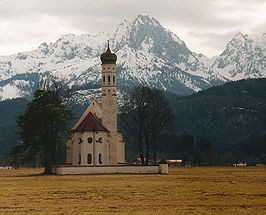
Bavarian church with
Alps in the background
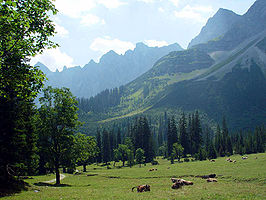
Though only a very small part belongs to the
Alps, the perception of Bavaria as an alpine region still endures.
Due to their long independence (until 1871), Bavarians have always maintained a strong national identity. Some features of the Bavarian culture and mentality are remarkably distinct from the rest of Germany. Noteworthy differences (especially in rural areas, less significant in the major cities) can be found with respect to:
Religion
The predominant faith is Roman Catholicism, particularly in Older Bavaria and Lower Franconia. Meanwhile, Lutheranism has a significant presence in large parts of Franconia. Religion remains important to many in the region, as expressed by the typical Bavarian and Austrian greeting: "Grüß Gott!" (God bless you). The current pope, Benedict XVI (Joseph Alois Ratzinger), was born in Marktl am Inn in Upper Bavaria.
Attitude towards traditions
Bavarians commonly emphasize pride in their traditions. Traditional costumes are worn on special occasions, century-old folk music is practised and dialect songs and poems are taught in nursery schools. The May Poles (which in the Middle Ages served as the community's yellow pages, as figurettes on the pole represent the trades of the village), and the bagpipes in the Upper Palatinate region bear witness to the ancient Celtic and Germanic remnants of cultural heritage of the region.
Food and drink
Bavarians tend to place a great value on food and drink. Bavarians also consume many items of food and drink which are unusual elsewhere in Germany, for example Weißwurst (white sausage). Beer in particular has always been regarded as a basic nutrient (Grundnahrungsmittel, or 'liquid bread'). Statistically, beer consumption per capita in Bavaria is higher than in the rest of Germany. At folk festivals, beer is traditionally served by the litre (the so-called Maß). Bavarians are particularly proud of the traditional purity law, initially established by the Duke of Bavaria in 1516. According to this law, only three ingredients were allowed in beer: water, barley, and hops. In 1906 the Reinheitsgebot made its way to German law and it is a law in Germany until today. Bavarians are also known as the most beerloving folk with an average annual consumption of 170 litres per person.
Language and dialects

Bavarian (blue), Franconian (green) and Alemannic German (red colour)
These three German dialects are spoken in Bavaria: Austro-Bavarian in Old Bavaria (South East and East), Swabian German (an Alemannic German dialect) in the Bavarian part of Swabia (South West) and East Franconian German in Franconia (North).
Bavarians are very proud of their marked dialects, and most of them speak with their Bavarian, Franconian or Swabian accent. As with traditions in general, cultivation of dialect and regional accent is not associated with backwardness, but is considered a strengthening of regional identity.
Historical buildings
| | | | |
| | | | |
Walhalla in Donaustauf near Regensburg
| | Cathedral and Oberhaus fortification in Passau
| |
| | | | |
| | | | |
| |
Miscellaneous
There are many famous people who were born or lived in present-day Bavaria:
- Pope Benedict XVI -- as of April 2005 he is the current Pope of the Roman Catholic Church. His baptismal name is Joseph Ratzinger.
- Painters such as Hans Holbein the Elder, Albrecht Dürer, Albrecht Altdorfer, Lucas Cranach, Carl Spitzweg, Franz von Lenbach, Franz von Stuck and Franz Marc.
- Musicians such as Orlando di Lasso, Christoph Willibald Gluck, Richard Wagner, Richard Strauss, Carl Orff and Theobald Boehm, the inventor of the modern flute.
- Modern musicians like Klaus Doldinger, Barbara Dennerlein and Amon Düül.
- Writers, poets and playwrights like Hans Sachs, Jean Paul, Frank Wedekind, Christian Morgenstern, Oskar Maria Graf, Bertolt Brecht, Lion Feuchtwanger, Thomas Mann and his sons Klaus and Golo Mann.
- Scientists such as Max Planck, Wilhelm Conrad Röntgen, and Werner Heisenberg, as well as Adam Ries, Joseph von Fraunhofer, Georg Ohm, Carl von Linde, Albert Einstein, Rudolf Moessbauer and Robert Huber.
- Well-known inventors such as Martin Behaim, Levi Strauss and Rudolf Diesel.
- Physicians like Max Joseph von Pettenkofer, Sebastian Kneipp and the neurologist Alois Alzheimer, who first described the Alzheimer's Disease.
- Footballers like Franz Beckenbauer, Sepp Maier, Gerd Müller, Paul Breitner, Klaus Augenthaler and Lothar Matthäus.
- Film directors Rainer Werner Fassbinder, Joseph Vilsmaier and Werner Herzog.
- Kaspar Hauser
- The Smith of Kochel
The motorcycle and automobile makers BMW (Bayerische Motoren-Werke, or Bavarian Motor Works) and Audi, Grundig (consumer electronics), Lucent Technologies (telecommunications infrastructure), Siemens (electricity, telephones, informatics, medical instruments), Adidas and Puma have (or had) a Bavarian industrial base.
A famous annual festival is called Oktoberfest or October Festival. It was first celebrated in 1810 as a public feast when the Bavarian crown prince Ludwig married Therese von Sachsen-Hildburghausen. The celebration originally was designed as a feast for all members of the Bavarian Nation, who should celebrate the country and the crown. It only turned to a pure matter of boozing in the 20th century and is nowadays attended rather by tourists than by Bavarians. Munich locals often despise it. It is celebrated during the two weeks leading up to the first Sunday in October.
Bavaria has also given its name to a major Dutch brewery, Bavaria Brewery.
The meaning of the coat of arms
Modern coat of arms was designed by Eduard Ege, following heraldic traditions in 1946.
- The Golden Lion: At the dexter chief, sable, a lion rampant Or, armed and langued gules. This represents the administrative region of Upper Palatinate.
- The "Franconian Rake": At the sinister chief, per fess dancetty, gules and argent. This represents the administrative regions of Upper, Middle and Lower Franconia.
- The Blue Panther: At the dexter base, argent, a panther rampant azure, armed Or and langued gules. This represents the regions of Lower and Upper Bavaria.
- The Three Lions: At the sinister base, Or, three lions passant guardant sable, armed and langued gules. This represents Swabia.
- The White-And-Blue Heart-Shaped Shield: The heart-shaped shield of white and blue fusils askance was originally the coat of arms of the Counts of Bogen, adopted in 1247 by the Wittelsbachs House. The white-and-blue fusils are indisputably the emblem of Bavaria and the heart-shaped shield today symbolizes Bavaria as a whole. Along with the People's Crown, it is officially used as the Minor Coat of Arms.
- The People's Crown: The four coat fields with the heart-shaped shield in the centre are crowned with a golden band with precious stones decorated with five ornamental leaves. This crown appeared for the first time in the coat of arms in 1923 to symbolize sovereignty of the people after the dropping out of the royal crown.
Arms of the Bavarian electorate 1753: http://en.wikipedia.org/wiki/Image:Bayern1753.jpg
Arms of the Kingdom of Bavaria 1807: http://en.wikipedia.org/wiki/Image:Bayern1807.jpg
Arms of the Kingdom of Bavaria 1835: http://en.wikipedia.org/wiki/Image:Bayern1835.jpg
Bavarian "citizenship"
The fact that unlike all other German Länder, Bavaria's constitution provides for Bavarian citizenship is often mentioned as an indicator for Bavarian distinctiveness. Some Bavarians are keen to emphasize that - in accordance with the generous indication of the constitution - they regard everyone
- born in Bavaria,
- born to a Bavarian parent,
- adopted by a Bavarian as a child,
- married to a Bavarian, or
- naturalized in Bavaria,
as a fellow-Bavarian; some of those falling under this untechnical definition express pride in being "Bavarian". However, state legislation regulating citizenship procedures has never been enacted, the constitution itself provides that all Germans enjoy the same rights as Bavarian citizens, and no office issues certificates concerning a "Bavarian" citizenship. Thus, the notion of citizenship rather bears a folkloristic, but not really political meaning.
However, many of those born in Bavarian clearly divide between born Bavarians and people that only moved to Bavaria. The nickname for all those who came to Bavaria is "Zuagroaste" ("those who have traveled here").
Many people in the northern part of Bavaria see themselves as Franconians and do therefore not like to be called "Bavarians". They have a separate dialect and don't wear traditional Bavarian clothing.
German-Bavarian relations
It is a common joke in Germany that Bavaria is not part of Germany. In fact a minority seriously agree with this notion; the Bayernpartei (Bavaria Party) advocates Bavarian independence from Germany. It is important to note that Bavaria was the only state to reject the West German constitution in 1949. However this has had no consequences on its implementation.
Population and area
| Administrative Region | Population (2005) | Area (km²) | No. municipalities |
| Lower Bavaria | 1,196,923 | 9.6% | 10,330 | 14.6% | 258 | 12.5% |
| Lower Franconia | 1,341,481 | 10.8% | 8,531 | 12.1% | 308 | 15.0% |
| Upper Franconia | 1,101,390 | 8.8% | 7,231 | 10.2% | 214 | 10.4% |
| Middle Franconia | 1,712,275 | 13.7% | 7,245 | 10.3% | 210 | 10.2% |
| Upper Palatinate | 1,089,543 | 8.7% | 9,691 | 13.7% | 226 | 11.0% |
| Swabia | 1,788,919 | 14.3% | 9,992 | 14.2% | 340 | 16.5% |
| Upper Bavaria | 4,238,195 | 33.8% | 17,530 | 24.8% | 500 | 24.3% |
| Total | 12,468,726 | 100.0% | 70,549 | 100.0% | 2,056 | 100.0% |
Bavarian culture overseas
The Bavarians take great pride in their culture. Traditions are taught to the children and descendants of Bavarian citizens through literature, music and cultural events. Whether actually in Bavaria, overseas or full citizens of other nations they continue to cultivate their traditions. They hold festivals and dances to keep their traditions alive.
In New York the German American Cultural Society is a larger umbrella group for others such as the Bavarian organizations, which represent a specific part of Germany. They proudly put forth a German Parade each year. Various affiliated events take place amongst its groups, one of which is the Bavarian Dancers.
Abroad, i.e. outside of Germany, especially in the United States and Asia, traditional elements of Bavarian culture, such as the Oktoberfest and the sporting of traditional costumes are often wrongly equated with German culture as a whole.
External links


